Should I use kernax?
tl;dr — if your project is JAX-based, yes.
Kernax kernels are plain Equinox Modules: they are pytrees, JIT-compiled, and fully compatible with jax.grad, jax.vmap, and jax.jit. If you already work with JAX arrays, there is virtually no overhead to adopting kernax, and you get fast Gram matrix computation on CPU and GPU for free.
When kernax shines
Pure JAX pipelines — GP regression, Bayesian optimisation, or any model that needs a covariance function and already lives in JAX. Kernels compose, differentiate, and JIT exactly like any other JAX operation.
Multi-task / multi-output GPs —
BatchModulelets you carry a distinct set of hyperparameters per task inside a single pytree, making batched GP inference straightforward.Custom kernels — the dual static/instance pattern makes it easy to write a new kernel and have it immediately compatible with JIT, grad, and all wrappers.
Comparison with other librairies
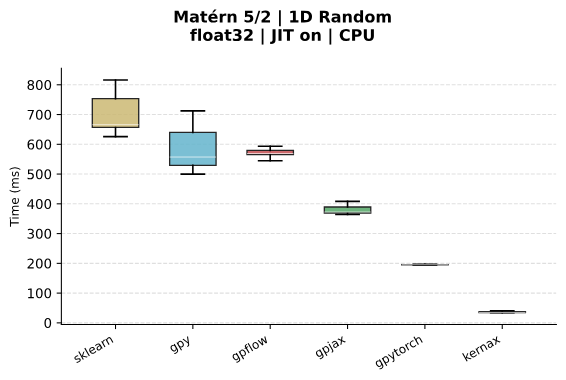
When jit-compilation is enabled, Kernax computes covariances way faster than any alternative on CPU.
When a GPU backend is available, Kernax gets even faster. The only library able to keep up with this performance is GPyTorch.
For a complete comparison, check out the Kernel Arena Repository
Snapshot from KernelArena (April 4th 2026):
When the benefit is more limited
If you are using PyTorch, have access to a GPU and want to learn parameters via Torch autograd, using GPyTorch is a better alternative.
Kernax computes dense covariance matrices, but if you want to perform exact GP inference on very large grid (multiple thousand of points), this quickly fills a lot of memory. Smarter alternatives have emerged to alleviate the problem, e.g. in GPyTorch or HiGP.